
Decode Microsoft's 451 4.7.500, 4.7.650, RP-001 and 550 5.7.515 responses, tell an Outlook incident from a reputation problem, and know what not to do.

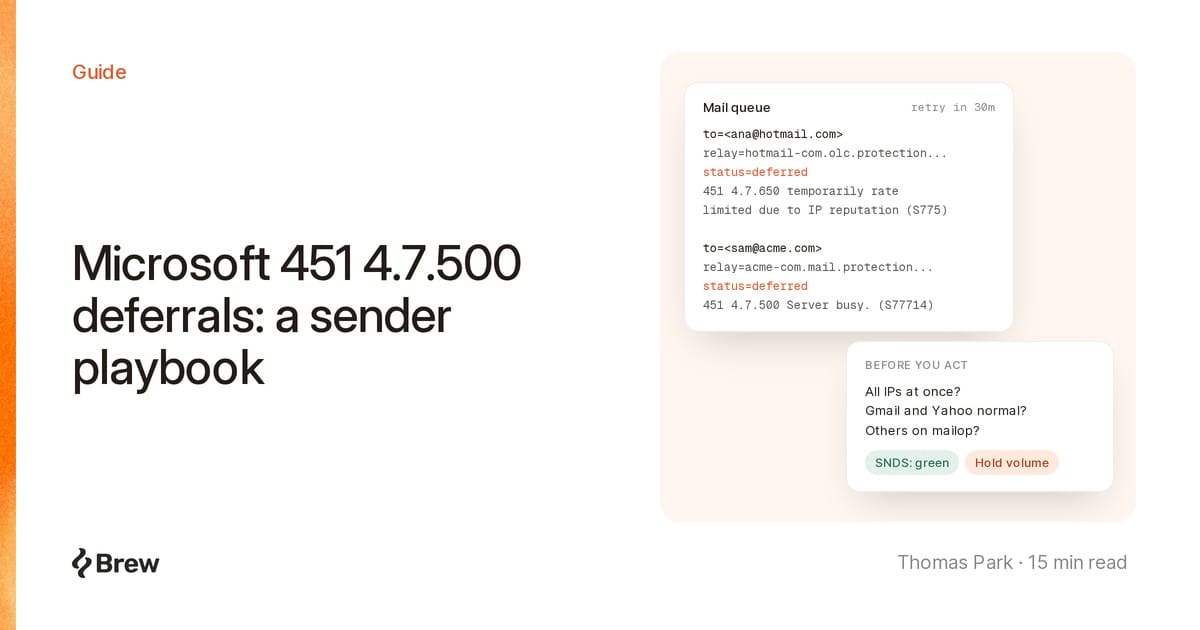
A Microsoft deferral is a temporary SMTP refusal, a response starting with 4, that Outlook.com or a Microsoft 365 server sends when it won't take your message right now. Your server should keep it and retry. The best known is 451 4.7.500 Server busy. Please try again later, and the same code can mean "your sending looks suspicious" or "Microsoft is having a bad day".
On September 4, 2026 it meant the second, and at least one experienced operator spent the morning chasing the first. Here's how to tell them apart.
*.olc.protection.outlook.com is Outlook.com consumer mail, *.mail.protection.outlook.com is a Microsoft 365 tenant. Different docs, different escalation.550 5.7.515 is always yours to fix.Microsoft runs two receiving systems.
Outlook.com is consumer mail: outlook.com, hotmail.com, live.com and msn.com, with MX hosts like hotmail-com.olc.protection.outlook.com. It has the Outlook.com Postmaster site, SNDS for reputation and its own sender support form.
Microsoft 365 (Exchange Online) hosts business mailboxes. Mail for acme.com goes to acme-com.mail.protection.outlook.com. Errors are documented on Microsoft Learn, blocks go through sender.office.com, and the recipient's admins control how their tenant treats you.
The domain name won't tell you which one you're hitting. The response will. In this log line posted to mailop on September 4, the relay= host is a Microsoft 365 tenant:
relay=xxxx-com.mail.protection.outlook.com[52.101.10.16]:25, dsn=4.7.500,
status=deferred (host xxx-com.mail.protection.outlook.com[52.101.10.16] said:
451 4.7.500 Server busy. Please try again later from [199.89.3.6]. (S77714)
[BN2PEPF000055E1.namprd21.prod.outlook.com 2026-09-04T10:28:53.346Z ...]
(in reply to end of DATA command))Read the basic code (451), the enhanced code (4.7.500) and the bracketed subcode like (S77714). Microsoft doesn't publish S-subcodes, but many senders reporting the same one at once is a signal.
| Response | Where | What Microsoft's docs say | First move |
|---|---|---|---|
451 4.7.500 Server busy. Please try again later from [IP]. (S77714) |
Microsoft 365 | Learn lists 4.7.500-699 as "Access denied, please try again later": suspicious activity, sending temporarily restricted. | Let the queue retry. Check scope first. |
451 4.7.500-699 (ASxxx) |
Microsoft 365 | IP throttling when the connecting IP "changed its previous email sending patterns by sending a much higher volume". | Slow the ramp. It clears "over a period of a few days". |
451 4.7.650 ... temporarily rate limited due to IP reputation (S775) |
Outlook.com | Not in Microsoft's published table. | Cut volume and concurrency, then check SNDS. |
451 4.7.652 ... exceeded the maximum number of connections (S3115) |
Outlook.com | Not in the table. The text names the cause. | Open fewer connections. |
421 RP-001, RP-002, RP-003 |
Outlook.com | Rate, per-connection rate and connection limits exceeded, "related to IP/domain reputation". | Throttle, then check SNDS. |
550 5.7.515 Access denied, sending domain [domain] does not meet the required authentication level. |
Outlook.com | Domain sends 5,000+ a day and fails the SPF, DKIM and DMARC requirement. | Fix authentication and alignment. |
550 5.7.1 ... part of their network is on our block list (S3150) |
Outlook.com | Block on your IP or range. | Stop sending from that IP and open a ticket. |
550 SC-001, SC-004, OU-002 and similar |
Outlook.com | Policy rejections for content, reputation or complaints. SC-004 points to JMRP. | Find the cause before resuming. |
550 5.7.606-649 Access denied, banned sending IP [IP] |
Microsoft 365 | IP is on the blocked senders list. | Request removal at sender.office.com. |
550 5.7.511 Access denied, banned sender |
Microsoft 365 | Needs manual investigation. | Forward the NDR to delist@microsoft.com. |
Sources: Microsoft's Exchange Online NDR reference, ASxxx article, Postmaster code table and 550 5.7.515 article; Al Iverson on S775 and S3115; Twilio SendGrid on S3140/S3150 blocks.
M3AAWG's Sender Best Common Practices say that after a temporary failure "the sender should close the connection and open a new connection later", and that senders must never treat a tempfail as permanent. Microsoft's sender policies on 5xx: "the sender must not attempt to retransmit that message to that recipient."
A 451 is not a bounce. If your platform or a script treats it as one, fix that first.
Microsoft's 4.7.500 guidance points you at your own sending. Usually that's right, but not always.
Qboxmail told mailop the problem "started at 9:47 CEST on all our IPs at once", with subcodes S77714, S77717 and S77719. Poppulo's status page quoted Microsoft's incident ID, EX1467029, starting 11:19 BST.
Per emailexpert's September 10 write-up, one operator blamed fiber cuts until One.com, Qboxmail, Mailjet and Poppulo reported the same codes across every sending IP and region. Microsoft blamed an anti-spam model, then a throttling rule still firing during recovery. emailexpert found no public post-incident report. A separate authentication fault, MO1465074, ran about 67 hours from August 31 to September 3. Our September report covers those ten days.
| Signal | Points to Microsoft | Points to you |
|---|---|---|
| Timing | Every IP starts in the same minute | One IP or domain, or a gradual climb |
| Other providers | Normal | Also degrading, or complaints rising |
| Other senders | Same code on mailop and status pages | Nobody else talking about it |
| Your recent changes | None | Volume jump, new IP, new list |
| SNDS | Green, no block | Yellow or red, complaints, "Blocked" |
| Code | 4.7.500 with a subcode others report | RP-00x, 4.7.650, 5.7.515, S3150 |
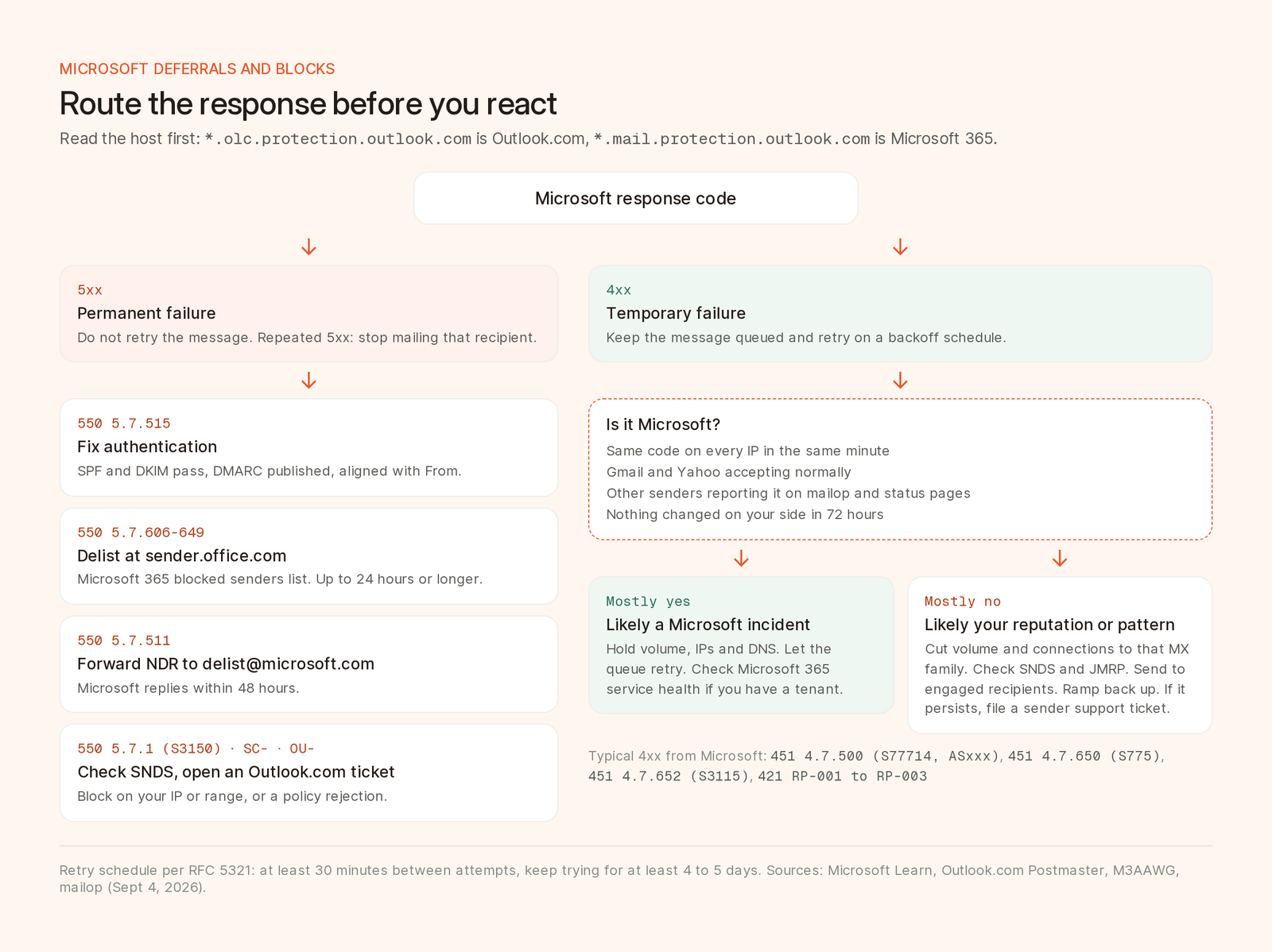
Routing a Microsoft response, from Microsoft's docs and the September 2026 incident reports.
Smart Network Data Services (SNDS) is Microsoft's free per-IP reputation portal for Outlook.com. The SNDS FAQ lists what each authorized IP shows:
Data "may not be present for IPs which sent less than 100 messages on the given day." To get access, request an IP, range or ASN, and SNDS emails a link to addresses it finds via reverse DNS (postmaster@, abuse@) or RDAP. No manual requests.
SNDS relaunched in June 2026. Al Iverson noted on June 19 that JMRP return-paths no longer reliably identify campaign and recipient, so encode those elsewhere. Per the SNDS home page (updated September 22), access expires 10 months after approval or migration, with three reminders. Calendar it.
The Junk Mail Reporting Program (JMRP), enrolled inside SNDS, returns each message an Outlook.com user marks as junk, often "within as little as 72 hours" of enrolling. Remove complainers from every list and enroll new IPs as you add them. On shared IPs you can't register, ask your provider what it watches.
Outlook.com. The support form on the Postmaster troubleshooting page needs a Microsoft account, covers only the four consumer domains, and "does not guarantee" delivery. Twilio SendGrid (vendor advice) says to include your domain, IPs, stream description, bounce text and SNDS screenshots, answer the automated first reply asking for escalation, and request your volume quota and a Volume-Based Limit review.
Microsoft 365. For 5.7.606-649, use the delist portal at sender.office.com: one address and one IP per visit, confirmed by email. Removal "might take up to 24 hours or longer." For 5.7.511, email the NDR to delist@microsoft.com, and expect a reply within 48 hours.
An ASxxx throttle has no delist. If the recipient company filters inbound mail through a third party before Microsoft 365, the Learn article says a connector set up by its admin removes the throttling. Otherwise it clears as you build history.
Retry on a schedule. RFC 5321, section 4.5.4.1 says "the retry interval SHOULD be at least 30 minutes" and the give-up time "generally needs to be at least 4-5 days," with two attempts in the first hour, then one every two or three hours. Don't shorten it for an urgent send.
Throttle per destination. M3AAWG says receivers expect adjustment "as a wholesale process for all emails sent to them by the same IP address." When Microsoft defers, slow everything to that MX family (Outlook.com or Microsoft 365).
Watch connections. Outlook.com policy says senders "must not open more than 500 simultaneous connections" without prior arrangement. That's a ceiling, and a 4.7.652 (S3115) means you're over yours.
Ramp new IPs and domains. Microsoft says a new IP "can expect to be fully ramped within a couple of weeks or sooner," depending on volume, list accuracy and complaints. New IPs covered by an existing SPF record inherit some domain reputation. Start with recent engagers.
5.7.515.For DMARC alignment and moving from p=none to enforcement, see our deliverability guide. To keep password resets and receipts moving, our transactional email guide covers putting them on their own domain.
Brew runs the sending infrastructure and retries temporary failures, so you never tune queues or connection limits. What you see:
delivery_delayed), and the recipient moves from accepted to delayed, then delivered or bounced. In Events, search "delayed", then type @hotmail.com or @outlook.com to narrow to Outlook.com (domain filters combine with OR; Microsoft 365 recipients use their own domains). The event says the message is waiting, not why.deliveryDelayed and pending beside delivered and bounced. get_email_analytics does the same over MCP.get_domain_health MCP tool. An inbox placement test (10 credits) hits seed mailboxes at Gmail, Outlook, Yahoo, Apple and others.Per-provider breakdowns, delivery webhooks and SNDS or JMRP data aren't in Brew yet, so use Microsoft's portals for reputation. During a suspected Microsoft incident, we'd leave the send alone and watch Delayed turn into Delivered.
It's a temporary refusal from Microsoft 365 (Exchange Online), listed as "Access denied, please try again later" after suspicious activity. Usually your sending pattern changed, but on September 4, 2026 it was a Microsoft incident (EX1467029). Let your server retry and check whether other senders see it too.
Microsoft says pattern-based throttling resolves "over a period of a few days" as you build history, and delisting can take up to 24 hours or longer. Keep retrying for at least 4 to 5 days, as RFC 5321 recommends, and most deferred mail still delivers.
Outlook.com rejects mail from domains sending 5,000 or more a day that miss its authentication rules, enforced since May 5, 2025. SPF and DKIM must pass, the domain must publish DMARC (p=none is enough), and SPF or DKIM must align with the From domain.
No. Microsoft says new IPs have no reputation and are more likely to have problems. Fix the cause, request delisting and ramp back up on the IP you have.
No. M3AAWG says senders must not treat a 4xx as permanent. It becomes a bounce only if retries run out or the server returns a 5xx. In Brew, a deferral shows as a Delayed event, and contacts are suppressed only after repeated soft bounces.