
Postmaster Tools v2 drops Gmail's domain and IP reputation charts. What v2 shows, where the API stands, and a weekly plan with thresholds to replace them.

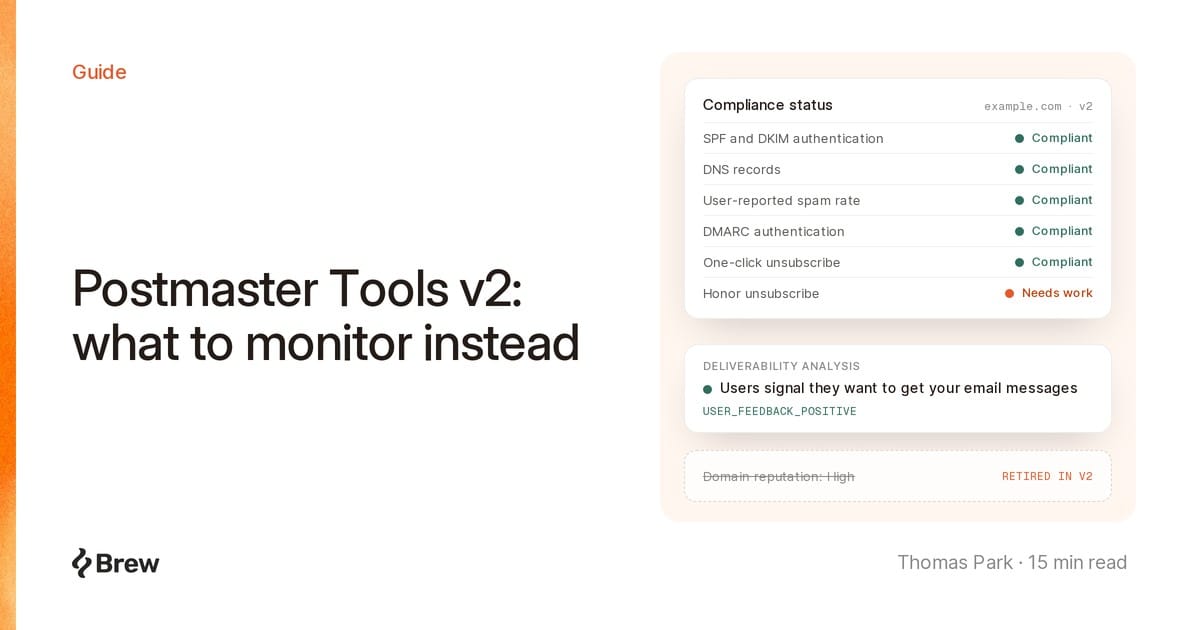
Google Postmaster Tools is Google's free dashboard that shows how Gmail treats bulk mail from a domain you have verified with a DNS record. Version 2 is replacing version 1 and drops the domain and IP reputation ratings many teams checked every morning. Here is what v2 shows, where the API stands, and what we check weekly instead.
Al Iverson at Spam Resource reported in September 2025 that "as of September 30, 2025, users will have access only to the newer (v2) version". Google paused in November 2025, then on August 20, 2026 he reported the pause was lifted: "GPT V1 is now being phased out."
The API timeline, from the Gmail API release notes:
| Date | What happened |
|---|---|
| 2024 | Postmaster Tools v2 launches alongside v1 |
| Dec 2, 2025 | v2beta API in developer preview |
| Feb 3, 2026 | API v2 generally available |
| Jun 24, 2026 | Domain and user management in the API; compliance status returns the deliverability verdict |
| Aug 20, 2026 | Spam Resource reports v1 access being removed account by account |
Google's pages lag. In early October its deprecation notice still said "we're postponing the deprecation of the legacy Postmaster Tools web interface" with no date, and the sender guidelines still say to check "your domain and IP address reputation with Postmaster Tools." For most accounts, v1 is already gone.
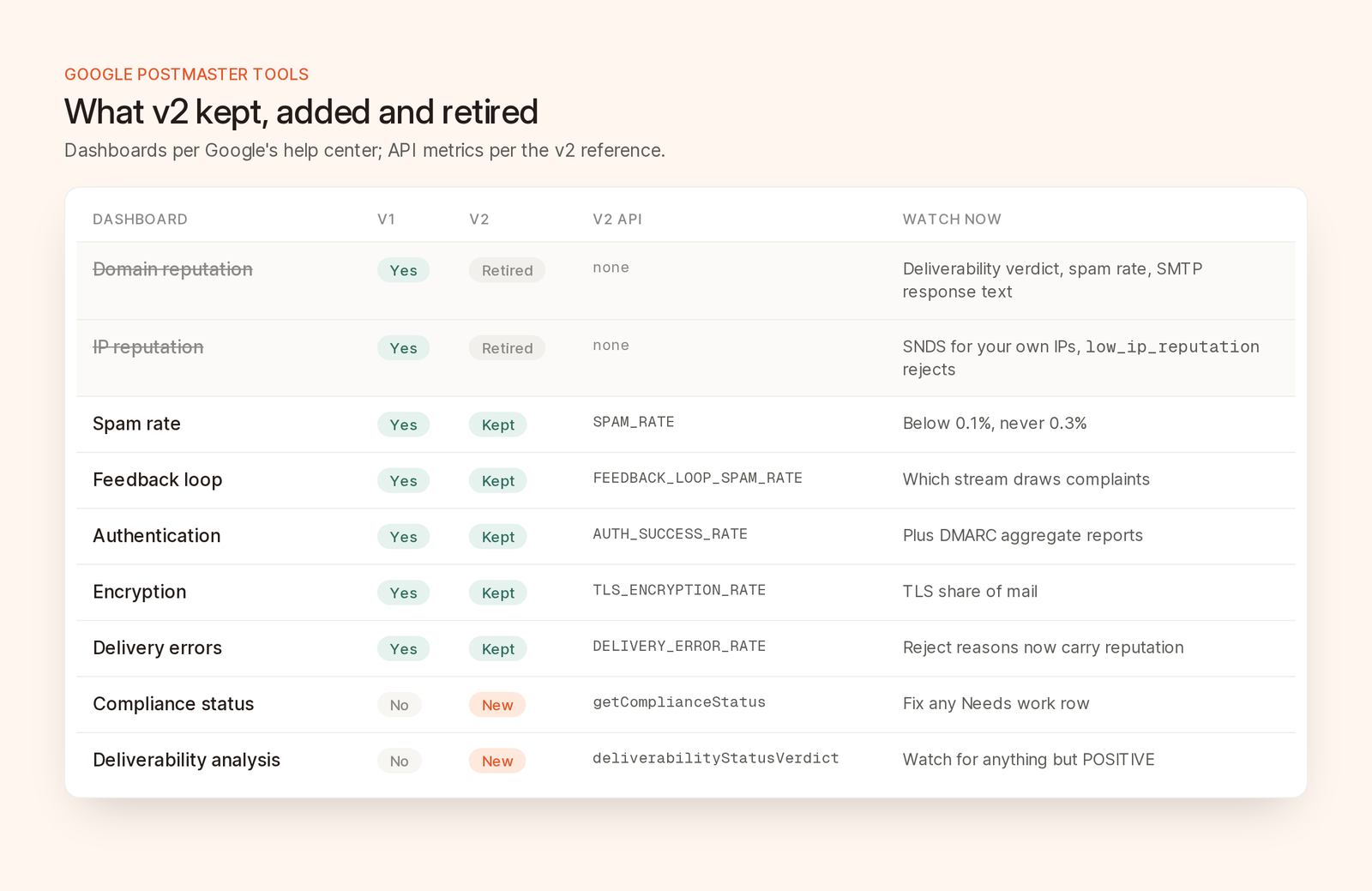
What carried over, what is new, and what to watch instead of reputation.
Per Google's dashboards help page, all dashboards cover personal Gmail accounts only, update within about 24 hours, use UTC, and can show gaps on low-volume days.
Every sender gets five checks against the sender guidelines: SPF and DKIM, DNS records, message formatting, encryption and spam rate. Bulk senders, about 5,000 or more a day to Gmail, add DMARC, one-click unsubscribe and honoring unsubscribes.
Rows read Compliant, Needs work or No data found. They are rolling averages, so a fix takes up to 7 days to show. It reports primary domains only: verify email.example.com and the rows cover all of example.com. "Honor unsubscribe" shows Needs work if opt-outs take over 48 hours, and Google counts a request even if your CDN or firewall blocked it.
The API returns this per-domain verdict as deliverabilityStatusVerdict from domains.getComplianceStatus. Iverson listed every message and its API value:
| Dashboard message | API reason | What to do |
|---|---|---|
| Users signal they want to get your email messages | USER_FEEDBACK_POSITIVE |
Nothing. This is the goal. |
| Not enough outgoing email | MESSAGE_VOLUME_LOW |
Send steadily and ramp slowly. |
| You don't meet our sender requirements | SENDER_NOT_COMPLIANT |
Fix the Needs work rows in Compliance status. |
| Many messages with delivery errors | SMTP_ERRORS_HIGH |
Read Gmail's 4xx and 5xx responses and slow down. |
| Users signal that they don't want to get your email messages | USER_FEEDBACK_NEGATIVE |
Review who you mail, how often and what you send. |
| Users don't take action on your messages | USER_FEEDBACK_LOW |
Cut long-inactive recipients and change the content. |
| Your spam rate is above 0.1% | SPAM_RATE_HIGH |
Urgent. Stop mailing the sources driving complaints. |
Watch USER_FEEDBACK_LOW. Nothing bounces, spam rate looks fine, and people are ignoring you. In v1 it looked like reputation sliding from high to medium.
Spam rate is the share of inbox-delivered, DKIM-authenticated mail that recipients marked as spam. Feedback Loop splits it by your Feedback-ID header to show which stream draws complaints. Authentication shows SPF, DKIM and DMARC pass rates, and Encryption the share sent over TLS.
Delivery errors matters most now: the share of authenticated mail Gmail rejected or deferred, with reasons. The v2 API's reject reasons are bad_attachment, bad_or_missing_ptr_record, ip_in_rbls, low_domain_reputation, low_ip_reputation, spammy_content, stamp_policy_error and other. Reputation survives only as a rejection, after it has cost you mail.
The old dashboards rated each domain and IP Bad, Low, Medium or High. Google's notice says the data "is not easily actionable for most senders," changes in behavior "are slow to reflect," and the dashboard "can be misleading as reputation is only one of many factors affecting deliverability."
Fair, and still a loss. As Iverson wrote in August, the chart showed a repair working over weeks. The verdict shows only today. New dashboards are promised, undated.
Google's migration guide for the generally available v2: trafficStats becomes domainStats, one domains.domainStats.query method replaces get and list, domainStats:batchQuery covers several domains per call, and domains.getComplianceStatus is new.
The v2 metrics are SPAM_RATE, FEEDBACK_LOOP_ID, FEEDBACK_LOOP_SPAM_RATE, AUTH_SUCCESS_RATE, TLS_ENCRYPTION_RATE, TLS_ENCRYPTION_MESSAGE_COUNT, DELIVERY_ERROR_COUNT and DELIVERY_ERROR_RATE. Google says v2 covers "all existing v1 functionality, except Domain and IP reputation," and that "the current v1 API will be retired." No date yet. Build nothing new on v1.
Daily spam and reject rates for one domain:
POST https://gmailpostmastertools.googleapis.com/v2/domains/example.com/domainStats:query
Authorization: Bearer <oauth-token with postmaster.traffic.readonly>
Content-Type: application/json

{
  "metricDefinitions": [
    { "name": "spam_rate", "baseMetric": { "standardMetric": "SPAM_RATE" } },
    {
      "name": "reject_rate",
      "baseMetric": { "standardMetric": "DELIVERY_ERROR_RATE" },
      "filter": "error_type = \"reject\""
    }
  ],
  "timeQuery": {
    "dateRanges": {
      "dateRanges": [
        { "start": { "year": 2026, "month": 9, "day": 28 },
          "end": { "year": 2026, "month": 10, "day": 4 } }
      ]
    }
  },
  "aggregationGranularity": "DAILY"
}
Both dates are inclusive. A missing day means low volume, not zero complaints. If an internal dashboard still reads v1 reputation, delete that panel.
No single signal replaces reputation, but together these warn you earlier than the old chart.
Google's sender FAQ says stay below 0.1% and never reach 0.3%. Above 0.1% already hurts bulk senders. At 0.3% you lose mitigation, and Google will not act on support requests until you stay below 0.3% for 7 consecutive days.
Gmail counts only inbox mail, so heavy spam-foldering makes the rate look healthy. Spam rate and clicks falling together is bad news.
Yahoo's sender best practices use the same 0.3% ceiling. An ESP that divides by all delivered mail, spam folder included, will read lower than both.
SMTP responses are your most direct feedback. Group bounces and deferrals weekly by provider and code. Key ones, from Google's SMTP error reference and each provider's pages:
| Provider | Response | Meaning |
|---|---|---|
| Gmail | 421 4.7.0 "very low reputation of the sending IP address" or "sending domain" |
Reputation problem, deferred. The text says which. |
| Gmail | 550 5.7.1 "likely unsolicited" or "very low reputation" |
Rejected as spam |
| Gmail | 421 4.7.28 "unusual rate of unsolicited email" |
Rate limited on IP, domain or a URL domain |
| Gmail | 4.7.27, 4.7.30, 4.7.31, 4.7.32 |
SPF failed, DKIM failed, no DMARC record, From not aligned |
| Microsoft | 550 5.7.515 |
A domain sending over 5,000 a day failed Outlook's authentication requirements |
| Yahoo | 421 or 451 |
Temporary, including complaints and unusual traffic (Yahoo error codes) |
| Yahoo | 553 or 554 |
Permanent, including DMARC failures and Spamhaus listings. Do not retry. |
Read the text after the code. Google's reference lists ten different 4.7.0 responses, from a missing PTR record to low domain reputation.
Gmail judges you by recipient behavior, so track unique human clicks per delivered message, per provider, per week. A drop at one provider usually means filtering there; a drop everywhere usually means content or audience changed.
Not opens: Apple's Mail Privacy Protection "downloads remote content in the background by default, regardless of whether you engage with the email." Drop security-scanner clicks too (how we count a real click).
One trap: Google Workspace companies use their own domains. Read gmail.com, outlook.com, hotmail.com, yahoo.com and icloud.com as providers, the rest as business mail.
A seed test reports inbox, spam or missing for fixed addresses at each provider. It catches what every recipient would hit: a broken DKIM key, a blocklisted link domain, spammy content. Seeds have no history with you, no opens, replies or "not spam" clicks, and Gmail decides partly per recipient. Yahoo's performance feeds page says panel and pixel-based tracking "can compromise the privacy and security of our users and violate our terms and policies." Run one after DNS, domain, template or link domain changes and before big sends. Never report it as your placement rate.
Yahoo's Sender Hub Insights view shows complaint rate and delivered count per verified DKIM domain, on inbox mail, above a minimum daily volume. Enroll the same domains in Yahoo's Complaint Feedback Loop for per-complaint reports; IP-based loops are gone.
Microsoft's SNDS, on a new portal this year, shows volume, complaint rate and a filter result per IP you control. The SNDS FAQ defines green as under 10% of messages judged spam, yellow as 10% to 90% and red as over 90%, and calls a complaint rate under 0.3% "a good bar." Access expires 10 months after approval or migration, so calendar the reattestation. Shared IPs cannot be registered, so ask your provider what it watches.
Aggregate reports show every source using your From domain, and whether SPF and DKIM passed and aligned. The format is now RFC 9990, published in May 2026, which with RFCs 9989 and 9991 replaces RFC 7489. Publish a rua address pointed at a tool that parses them:
_dmarc.example.com. IN TXT "v=DMARC1; p=quarantine; rua=mailto:dmarc-reports@example.com"Look for new sources, falling DKIM alignment and unfamiliar volume. After a sudden Gmail drop, we check authentication first; it is usually the fastest fix.
Then blocklists. The Spamhaus Domain Blocklist covers domains, including link and image domains in your body; the SBL covers IPs. Gmail reports listings as ip_in_rbls.
The 0.1%, 0.3% and SNDS figures come from Google, Yahoo and Microsoft. The bounce and click thresholds are ours, so adjust them to your baseline.
| Check | Where | Healthy | Act when | First action |
|---|---|---|---|---|
| Gmail spam rate | Postmaster Tools v2 or API | Under 0.1% | 0.1% or more on any day | Find the stream in Feedback Loop and pause it |
| Gmail verdict | Deliverability analysis | USER_FEEDBACK_POSITIVE |
Any other verdict for 2 weeks | Follow that verdict's action above |
| Gmail compliance | Compliance status | All Compliant | Any Needs work | Fix, then allow 7 days to update |
| Yahoo complaints | Sender Hub Insights | Well under 0.3% | Rising 2 weeks running | Check feedback loop reports by campaign |
| Outlook IPs | SNDS (own IPs only) | Green | Any yellow or red day | Compare that day's volume and audience |
| Bounces and deferrals | Bounce log, by provider | Under 1% hard bounces | Over 2%, or reputation or rate-limit text | Slow the send and read the full response |
| Clicks per provider | Your analytics | Within 20% of 8-week average | One provider down 20% or more | Seed test the next send, trim inactives there |
| Authentication | DMARC aggregate reports | Known sources pass and align | New source or falling alignment | Fix DNS or the vendor's DKIM before sending |
| Blocklists | Spamhaus lookup | Not listed | Any listing | Find the cause, then request delisting |
| Seed test | Placement tool | Inbox at each major provider | Spam at any provider | Diff against the last passing version |
Brew covers the checks drawn from your own sending. Keep Postmaster Tools, Sender Hub and SNDS open alongside it.
get_domain_health (MCP tool, or GET /v1/domains/{domainId}/health) is free. It returns a healthy, at_risk or critical verdict, SPF, DKIM and DMARC state, a 0 to 100 score with a trend, and signals with suggested fixes. Its "reputation" pillar uses Brew's own bounce and complaint rates from your campaign and automation sends, per domain when volume allows and otherwise workspace-wide. That pillar is 25% of the score and uses the same 0.1% and 0.3% marks; 0.3% or more with at least three complaints caps the score at 40. include=scoreHistory returns up to 50 snapshots, so you get a trend line back.
create_inbox_placement_test sends a real email through your verified domain to seed inboxes at Gmail, Outlook, Yahoo, Apple and others, for 10 credits plus the small send. Verifying a marketing domain also triggers one free run of five template variants, plain text to promotional. The seed caveats above apply.
For clicks by provider, use the events feed twice: GET /v1/analytics/events?eventType=clicked&groupBy=recipientDomain&bucket=week, then the same with eventType=delivered. Divide one by the other per domain and week. Bot clicks are excluded by default. These are event counts, so a person who clicks twice counts twice; that is fine for spotting a 20% drop at one provider, but it is not the unique click rate on your send reports. Grouped counts read the newest 20,000 events, so for a high-volume list pass from and to one week at a time and check the truncated flag. Swap in bounced, complained or delivery_delayed for problems; status codes stay in your bounce log.
No. Neither v2 nor its API has a reputation metric. Low reputation appears only as a Delivery errors rejection reason, and the Deliverability analysis verdict is the nearest replacement.
Google says to stay below 0.1% and never reach 0.3%. Above 0.1% already hurts bulk senders, and at 0.3% Google will not help until the rate stays below 0.3% for 7 consecutive days.
Google says the v1 API will be retired and to migrate to v2, generally available since February 3, 2026, but has set no date. v2 covers everything except reputation.
Postmaster Tools hides data on days with low volume to personal Gmail accounts. Spam rate counts only DKIM-authenticated mail, and the verified domain must match the DKIM or SPF domain on your mail. The Deliverability analysis says "Not enough outgoing email" when Gmail cannot judge your domain yet.
For problems every recipient hits, such as failed authentication or a blocklisted link, yes. They miss subscriber engagement, so judge real placement from spam rate, clicks per provider and the Gmail verdict. Our deliverability guide and the September State of Email cover the wider context.