
Automations built to run for months
Lifecycle teams asked for automations they can trust for a year. Now every step runs on the latest Brew, contacts recover on their own, and Retry is safe.

The automations our customers build are getting longer. A welcome series used to be three emails over a week. Now it's a 90-day onboarding program with a 30-day wait in the middle, a renewal reminder scheduled for next spring, and a win-back flow that checks in after six months.
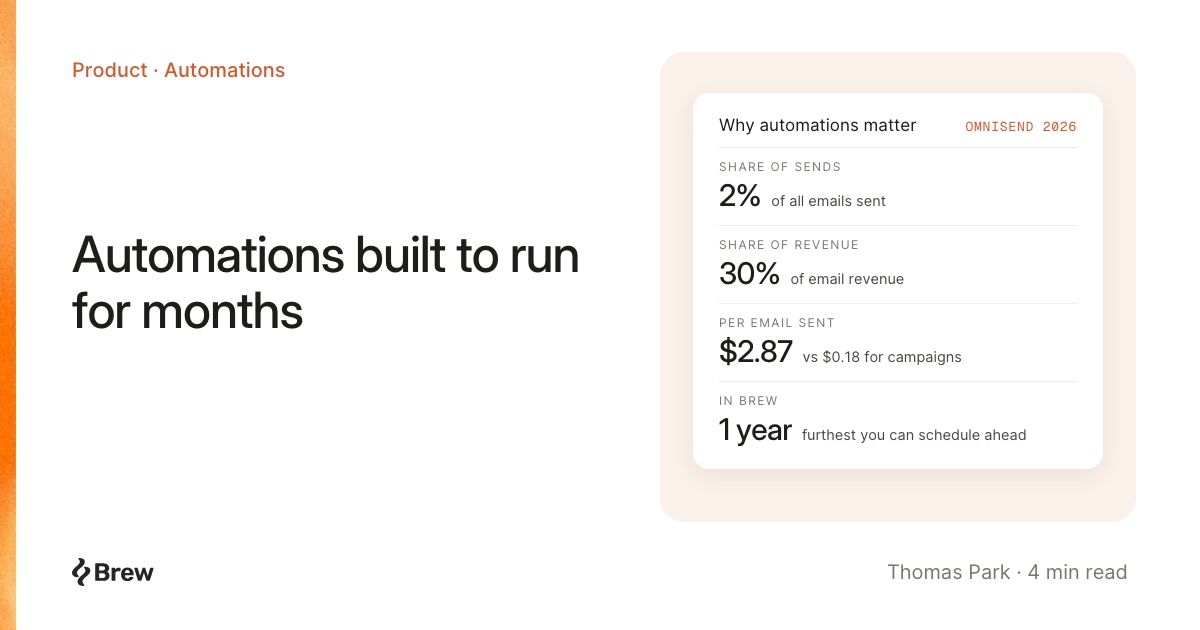
There's a good reason for that. Automated email does more with less. Across 150,000 ecommerce brands, Omnisend found automations were 2% of emails sent but 30% of email revenue in 2025, earning $2.87 per send against $0.18 for campaigns (Omnisend 2026 report, vendor data). Selzy's mid-2026 benchmarks put triggered emails at a 6.4% click rate against 1.2% for mass campaigns (Selzy).
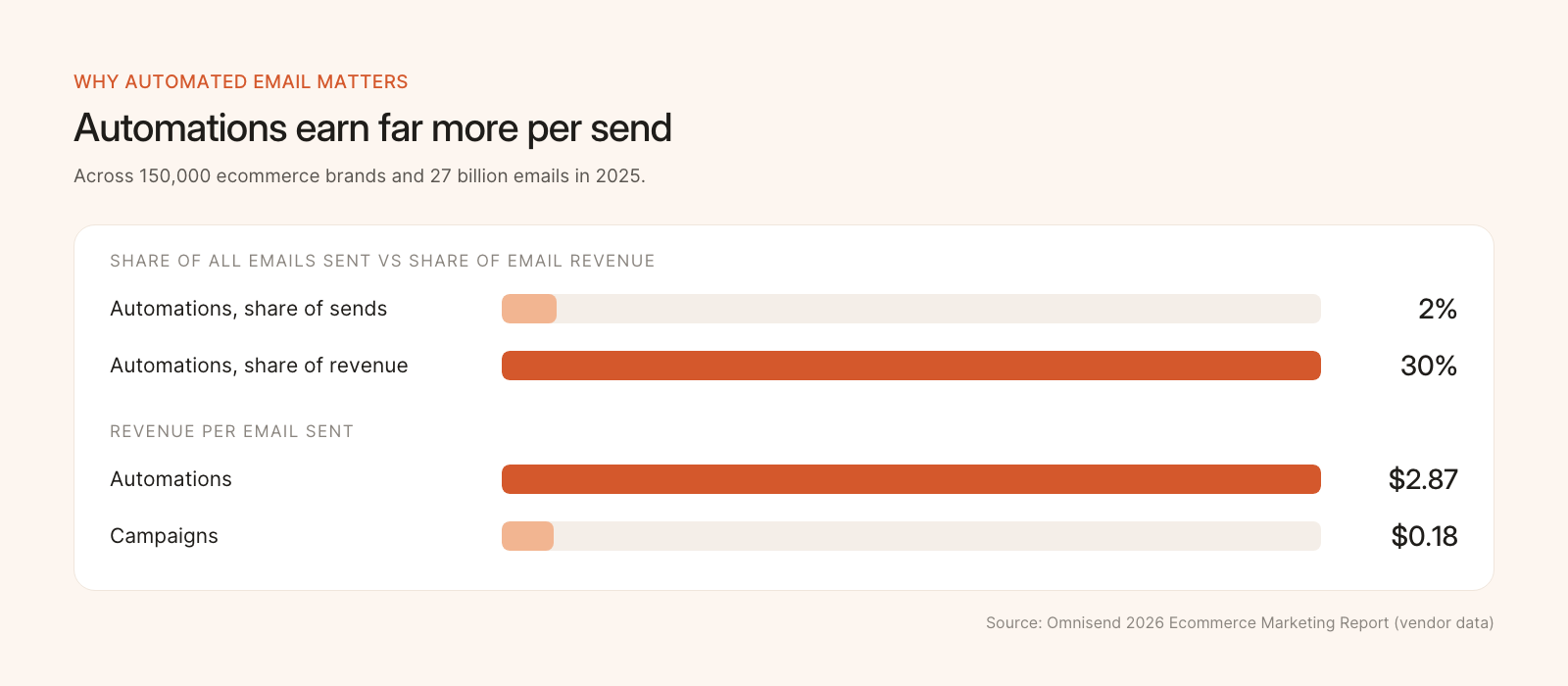
Automations are a small share of sends and a large share of revenue. Omnisend vendor data, 2025.
Lifecycle marketers and the engineers who wire up their events asked us for the same thing: set it up once, and trust it for a year without checking. This month we rebuilt how automations run to make that the default.
Every step runs on the latest Brew
We ship improvements to Brew many times a day. Until now, a contact moved through an automation on the version of Brew that enrolled them. A contact who joined in August finished their journey in November on August's Brew.
Now each step runs on the current version. A contact who's 60 days into a 90-day series gets today's rendering, today's deliverability checks and today's fixes on their next email. Long waits of 30, 60 or 180 days pick up exactly where they left off.
Brew watches every contact in flight
Brew now keeps an eye on every contact moving through an automation. If one stops moving, on a wait, after a send, or between steps, Brew notices and continues them from where they stopped. It handles thousands of contacts an hour, so a busy automation with a large audience keeps flowing.
When a contact can't continue, the run says why in plain words.
Retry picks up where it left off
Retry on a run now continues from where that run stopped. Emails the contact already received are skipped, so nobody gets the same message twice. If Brew can't confirm whether an email went out, it stops at that step and tells you, so you decide.
Each run can be retried once, so a teammate in another tab can't start a duplicate.
Schedule as far ahead as you need
You can schedule a campaign or an automation run up to a year ahead. Brew holds it and starts it on time, on the latest version. Plan the Black Friday reminder in September and forget about it.
Large sends and long Stripe histories now run in chunks behind the scenes, so even a very big list goes out in one smooth send.
See the health of every connection
Most automations start from an event in another tool: a signup in Supabase, a payment in Stripe, a form in Framer. More of that data now arrives through agents, too. HubSpot said customers created more than 22 million CRM records through ChatGPT and Claude connectors last quarter (earnings call). The more places your contacts come from, the more it matters that every connection is healthy. If one is set up with mismatched secrets, its events can't get through.
Each integration now shows Needs attention when its events are being refused, with a banner telling you exactly what to fix. If it continues for a couple of hours, you get a notification.
Test emails go to your team
Test sends from the editor and from automations now go to you, people at your company's domain, teammates on the brand, or addresses on your verified sending domains. It keeps drafts inside your company until they're ready, and it's one less way for a test to reach a customer by mistake.
Get the most out of it
A few minutes to set your account up for the long haul:
- Open Integrations and check that every connection reads Connected.
- Open your longest automation and look at Runs. You'll see each contact's progress and, for anything that stopped, the reason.
- Schedule the next big moment now, whether that's a seasonal campaign or a renewal reminder.
- Add teammates to the brand so they can receive your test emails.
For how agents are changing the rest of email, see The state of agentic email marketing in 2026.
Thanks to the lifecycle teams who shared their longest flows with us. They shaped every part of this.
The changelog has the full list: Automations built to run for months.